

Presence and Lucidity
By Alexandra Pierre
April 2026
What meaning does presence take in a complex and imperfect world? With this text, inspired by her participation in a Brèches conversation, writer Alexandra Pierre, a feminist and anti-racist activist, invites us to think about presence through the lens of resistance. As a way of “sustaining the beauty of the world while recognizing injustices, and choosing to confront them, for the sake of what is to come.”
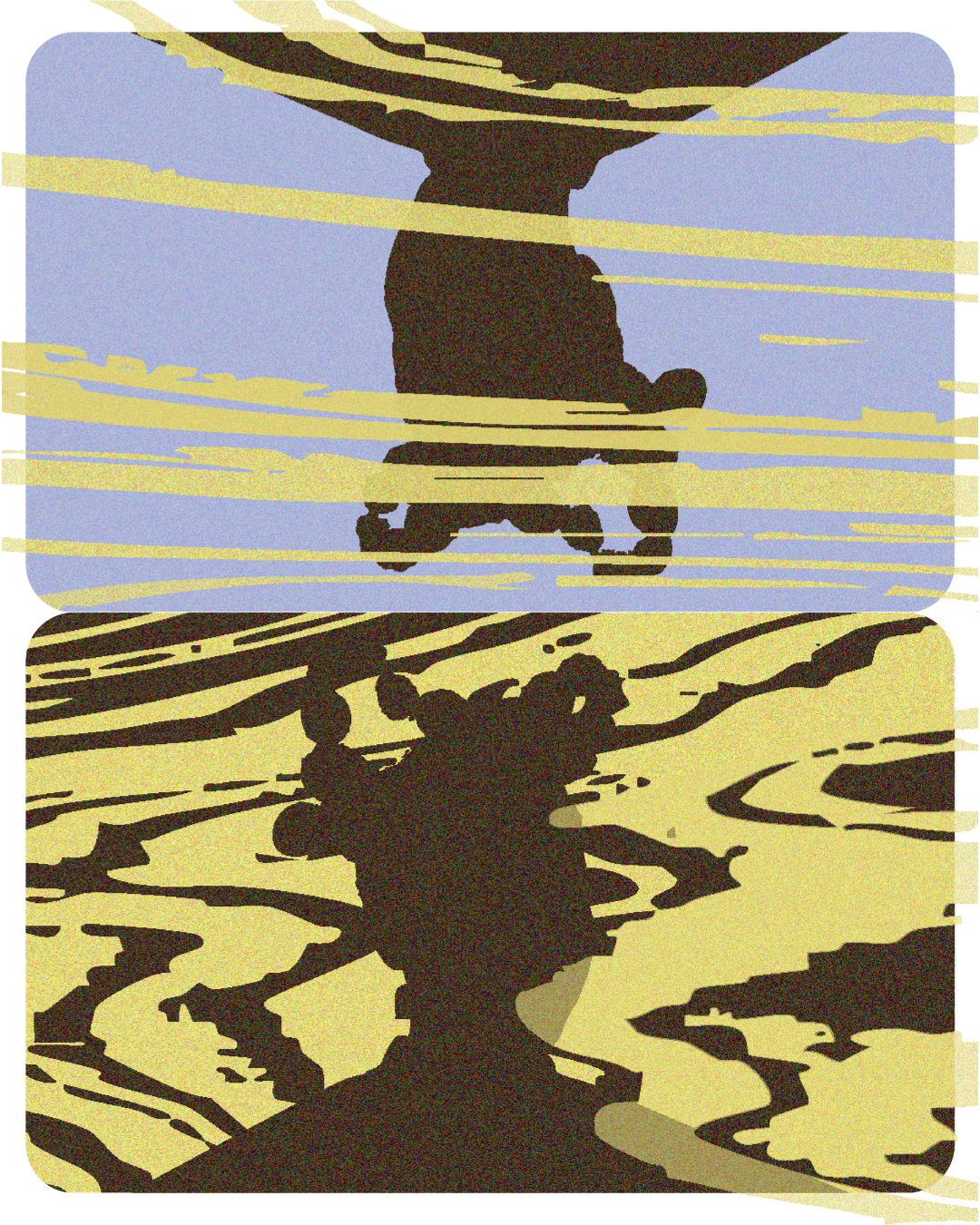
illustration by Fatou Dravé
In the fall of 2024, Brèches organized a conversation on what presence is, more specifically on what limits it and what can liberate it. The exchange was preceded by a musical improvisation by Théo Abellard, jazz pianist, and Marie-Ketely Abellard, double bassist. Around ten people took part in the conversation, including the two musicians, each bringing an angle or perspective on presence.
For nearly an hour, we discussed the difficulty of being present in an era marked by the acceleration of time and the commodification of our cognitive attention. We spoke about the technologies of time that make it more difficult to settle and pay attention to the here and now. A specialist in neuroscience and brain plasticity spoke about the neurobiological basis of presence, the neural networks that support it or, on the contrary, hinder it, before the exchange shifted toward the spiritual and psychological dimensions of presence, particularly in the way we conceive of our relationships with others and with our environment.
Several participants first associated presence with privilege. I was struck, for example, by a reference to Maslow’s hierarchy of needs, which suggested that if one is consumed by concerns of survival or by unmet basic needs, it would be difficult, even impossible, to “be present.”
But this perception did not correspond either to the experiences or to the intellectual traditions that have shaped me, whether through family transmission or through Black activist communities in Montréal. Indeed, many marginalized populations, deprived of decent living conditions, have developed forms of presence necessary to live in environments shaped by colonialism, racism, or exploitation. This presence in the world takes the form of a kind of acuity, a heightened lucidity, that allows them to respond to their surroundings and to the dynamics unfolding there. The experiences as well as the intellectual traditions of Black communities in the Americas can shed light on the question of presence as a form of resistance. How can one survive in a hostile world without this heightened awareness of racial dynamics that are too often obscured?
A differentiated presence
Beginning in the fifteenth century, European colonial powers undertook the conquest of Africa, the Americas, and Asia in order to profit from subjugated territories. To justify this domination, they constructed the image of the “Other” as an inferior being, subhuman — even nonhuman in the case of anti-Black racism. This conception of beings supposedly destined by nature to be exploited or eliminated served to justify the enslavement of Black and Indigenous people in the Americas, including here in Québec, as well as the genocides of Indigenous peoples on Turtle Island: murders, forced labor and displacement, the establishment of reserves, residential schools, the removal of children for adoption, disappearances within social services, forced sterilizations, and so on. Artists Émilie Monnet and Marilou Craft bear witness to this, in fact, when they tell the stories of Marie-Josèphe-Angélique and Marguerite Duplessis [1] , neighbours living in what is now the Old Port district of Montréal. These women — one Black, the other Indigenous, like our two artists — were enslaved in the eighteenth century. Both left their mark on the history of this territory by refusing their dehumanization. One attempted to flee her captivity and, for this, was accused of having set fire to Montréal, then hanged. The other was the first Indigenous woman to initiate legal proceedings in New France and the first enslaved person to contest her status as a slave before the courts.
This quest for freedom and the many attempts at escape attributed to Marie-Josèphe Angélique echo marronage, the individual or collective flight of enslaved people from plantations, mines, or other such places. In order to survive, maroon communities had not only to find refuge in inhospitable environments that they eventually came to know how to inhabit, but also to develop a fine-grained understanding of the functioning of slave societies and of the psychology of settlers. Maroons took refuge in isolated and hard-to-reach areas (mountains, forests, swamps...) in order to escape durably from the slave system and its extreme exploitation. Faced with these forms of violence, which to this day remain one of the underlying threads of racial inequality, the intellectual traditions of Black communities in the Americas can illuminate the question of presence. Several thinkers and activists have reflected on the concept of double consciousness, or analogous notions: developing an acute sense of one’s own interests in order to work toward one’s liberation, while also intimately understanding the mechanisms of colonial, slaveholding, and oppressive societies.
Double consciousness: thinking about presence in a context of colonial domination and racial violence
In The Souls of Black Folk (1903), W. E. B. Du Bois introduces the concept of double consciousness, that is, the experience of a self divided between two poles: the one imposed by the gaze of a racist white society, and the one rooted in one’s own lived experience and in the experience of Black communities. This duality allows one to see the world both from the inside and from the outside, generating a formidable capacity for sociopolitical analysis. It makes visible what escapes (or is ignored by) the dominant gaze, and becomes a vital tool for adapting, protecting oneself, and surviving. Maroon societies offer a powerful example of the necessity of cultivating a double consciousness.
In Black Skin, White Masks (1952), Frantz Fanon, a Martinican psychiatrist and anticolonial activist, highlights the fact that colonized people develop a critical consciousness under oppression — that is, a fine-grained understanding of their condition and of the colonizer’s psychology. For his part, James Baldwin, the American writer and essayist, notes that Black people have developed a sharpened understanding of the fears and hypocrisies of white people: the colonized know more about the colonizers than the reverse, because their lives depend on it.
Similarly, bell hooks, the Black feminist theorist (Ain’t I a Woman? Black Women and Feminism, 1981), emphasizes the skill of Black women living in white societies in analyzing the systems of oppression that shape their lives. She also shows their capacity to resist them, for example through an oppositional gaze directed at the media, one that sheds light on the biases and lies of dominant representations.
Double consciousness, also a local matter
The history and racial dynamics unfolding on the territory now called Québec are of course deeply influenced by those that have traversed and continue to traverse the Americas as a whole. Many examples demonstrate, particularly through the experiences of Haitian women, the relevance of the notion of double consciousness. For example, when they recount their arrival in Québec to participate in building the Quiet Revolution, they lucidly analyze their social position, marked by “a triple problem: [being] women, Black and immigrants. And to that is added another dimension, that of social class [...]. [...] in the 1980s, before the Congress of Black Women had banged its fist on the table, it was white women who spoke for us. We were domestics, our role was to take care of those women’s families while they went into the public sphere. That is why our discourse as Black and Haitian women has always disturbed certain groups.”[2]
Several of these testimonies highlight this singular lucidity with regard to the dynamics of Québec society and to the concrete forms of marginalization experienced by Black women.
Similarly, the exhibition Aunties’ Work, The Power of Care, presented at the McCord Museum from October 23, 2025, to April 12, 2026, underscores the power of care carried by the matriarchs of Montréal’s Black communities. Without their presence — understood as grounding, as a point of reference, but also as an ethical and philosophical stance — social ties, collective movements, and relationships themselves would be more fragile. The exhibition also insists on the question of the transmission of resources and crucial postures, woven through collective experience, that make it possible to navigate the world as a Black person. These “tantines” cultivate a sense of community, belonging, and self-worth in the people who cross their path, thus strengthening the capacity to confront violence, discrimination, and structural obstacles together.
In this sense, their lucid presence in the world, inherited, transmitted, reinvented, nourishes both individual and collective resilience.
Presence and resistance
The conversation organized by Brèches reminded me of the extent to which the experiences of racialized groups can contribute to understanding the world in all its complexity. One of the strengths of Black feminisms, in my view, lies in their aptitude for thinking about their environment in its imperfection rather than from an abstract and mistaken ideal [3].
From this perspective, presence does not unfold only under ideal conditions, free of constraints — for example, in a context where all our basic needs would be met.
For many Black communities that live or have lived through everyday marginalization, presence is also located (and perhaps above all) in the interstices created by a lucid resistance, transmitted and reinvented from generation to generation.
But ... these perspectives too often remain ignored, silenced. Black feminists often speak of “situated knowledge” in order to challenge the claim to universality of white people’s experiences and of the conceptions that arise from these dominant societies. They remind us that all knowledge is necessarily partial, rooted in specific social positions. Any possible capacity to apprehend totality — insofar as that is even possible — can emerge only from intersecting perspectives, arising from the plurality of such forms of knowledge.
Belonging to racialized groups often implies a singular posture: that of learning to navigate between several worlds, to live with the biased representations produced by dominant groups, to decipher the unspoken and hidden signs in order to ensure one’s safety and survival. This lucidity also imposes a specific relation to time: it requires understanding how the past shapes the present, in terms of oppression as well as resistance. The present is never simply the present: “we are constantly unfolding multiple pasts and, in doing so, we also open up possible futures,” philosopher Jonathan Martineau [4] reminded us during that conversation in the fall of 2024, at the Cité-des-Hospitalières.
The fact of having to grasp one’s environment and the relationships at play within it, because one’s very existence depends on it, makes one profoundly present to the world. Presence, then, is also this: to witness and sustain the beauty of the world while recognizing injustices, and choosing to confront them... for the sake of what is to come.
Notes
[1] See the co-authored foreword in Pierre, Alexandra (2020). Empreintes de résistance. Filiations et récits de femmes Autochtones, Noires et racisées. Montréal: Éditions du Remue-Ménage.
[2] Activist Yolène Jumelle, in Sroka, G. B. (1995). Femmes haïtiennes: paroles de négresses. Montréal: Les Éditions de La Parole Métèque.
[3] See also Charles W. Mills (2023), Le contrat racial. Translated by Aly Ndiaye (alias Webster). Montréal: Mémoire d’encrier.
[4] See also Jonathan Martineau’s triptych on this site.
